
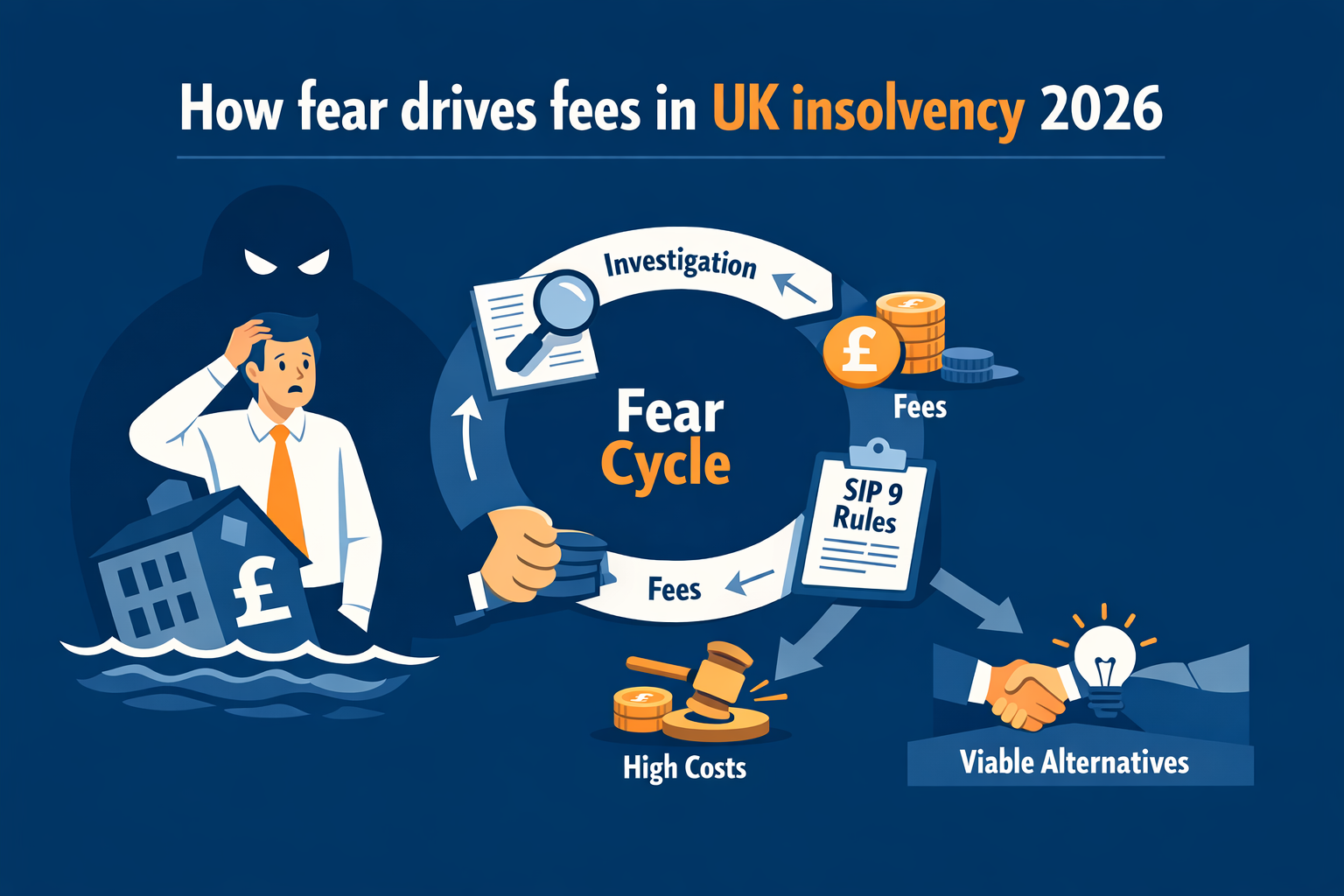
Directors across the UK keep telling us the same story: what starts as a safeguarding talk ends as a claims machine. Insolvency is supposed to stabilise a mess. Too often it runs on something else - a circular fear economy that turns risk warnings into revenue. Here is how the loop forms, and how you can step out of it without breaching the law or short-changing creditors.
In the first call, directors hear a blunt script: handle this correctly or expect investigations, personal claims, disqualification or worse. Those risks are real under the Insolvency Act 1986 and the Company Directors Disqualification Act 1986. What is rarely explained with equal clarity is that the same firm raising those risks may later be appointed to investigate the conduct, assess the director’s loan account, and consider claims. It is lawful. It is regulated. It is not neutral, because the work created pays the bills.
Many enter a Creditors’ Voluntary Liquidation believing candour will be met with a contained, administrative process. Instead they encounter months of queries, combative letters about loan accounts and dividends, and settlement demands on marginal points to bring matters to a close. The shock is not scrutiny itself; it is the gap between the reassurance offered pre‑appointment and the adversarial reality that follows.
To understand why, follow the incentives. Statement of Insolvency Practice 2 requires office‑holders to investigate and report. Statement of Insolvency Practice 9 governs remuneration and narrative reporting to creditors. Time‑cost billing and percentage recoveries are permitted if properly approved. The more hours spent on investigations and the more claim activity pursued, the more revenue is typically generated. None of this breaches a rule, but it shapes behaviour in predictable ways unless creditors and directors insist on boundaries.
The loop is easy to trace. Fear of personal exposure compels full cooperation and disclosure. That disclosure feeds investigation lines. The investigations turn into claim letters and Part 7 filings. Confronted with rising costs and uncertain outcomes, directors pay to settle. The cycle sustains itself: the risk that created compliance now funds the work that monetises it.
What is seldom emphasised at the outset is that investigations are commercially incentivised, that ambiguous positions - a book‑keeping error, a shaky solvency test, an overdrawn director’s loan - may still be pursued, and that settlement is often presented as the rational way to contain costs even where liability is arguable. The process is framed as ‘just procedure’. In practice, it is a contest, even when no dishonesty is alleged.
Director‑led alternatives disturb this model. Quiet pre‑insolvency correction, independent compliance reviews, Time to Pay with HMRC, and targeted negotiations with key creditors remove easy misfeasance angles and lower the heat. They also reduce the investigative canvas and the fee opportunity. From a state perspective, formal appointments are safer: licensed, insured and predictable. Independent operators who steady the ship without an appointment create fewer problems but sit outside familiar control. The resistance is less moral than structural.
None of this is permission to shuffle assets or prefer insiders. It is a prompt to act early and record decisions. Before running to a liquidator, commission an independent review that will not turn into the future office‑holder. Fix record‑keeping, reconcile the director’s loan account, and test dividend legality against Companies Act capital rules. Where the business remains viable but tight on cash, agree a Time to Pay with HMRC and set milestones with trade creditors in writing. Where a formal restructuring is justified, consider a Company Voluntary Arrangement for SMEs or, in larger cases, a Part 26A restructuring plan - with fees and deliverables set out up front.
If a CVL or administration is unavoidable, reset the terms. Ask the proposed office‑holder to define the scope of investigations, the SIP 9 remuneration basis, budgets, caps and the triggers for any variation. Seek a clear explanation of the director conduct report and expected timelines. Push for early creditor oversight and, where appropriate, a committee so fees are monitored by people with skin in the game. This is not confrontation; it is governance.
Remember that the statutory conduct report to the Insolvency Service is not a verdict. Provide contemporaneous documents, board minutes and cashflow evidence rather than speculation. Keep correspondence factual and resist open‑ended commentary on blame. If legal advice is needed, obtain it independently and in writing rather than channelling it through the insolvency firm.
Creditors want recoveries, not churn. Directors can help by setting out a realistic asset‑and‑claims picture and backing proportionate fee bases with narrative milestones. Creditors retain rights to challenge remuneration in court if value is not delivered, but it is far cheaper to set expectations and controls at the beginning than to litigate after the money has gone.
Formal insolvency has a place. So does quiet pre‑insolvency repair. They are not moral opposites: one is statutory, the other preventative. The problem is when fear becomes the sales engine. Replace fear with facts, price the work properly, and choose the route that delivers outcomes for creditors without turning directors into fuel for the machine.