

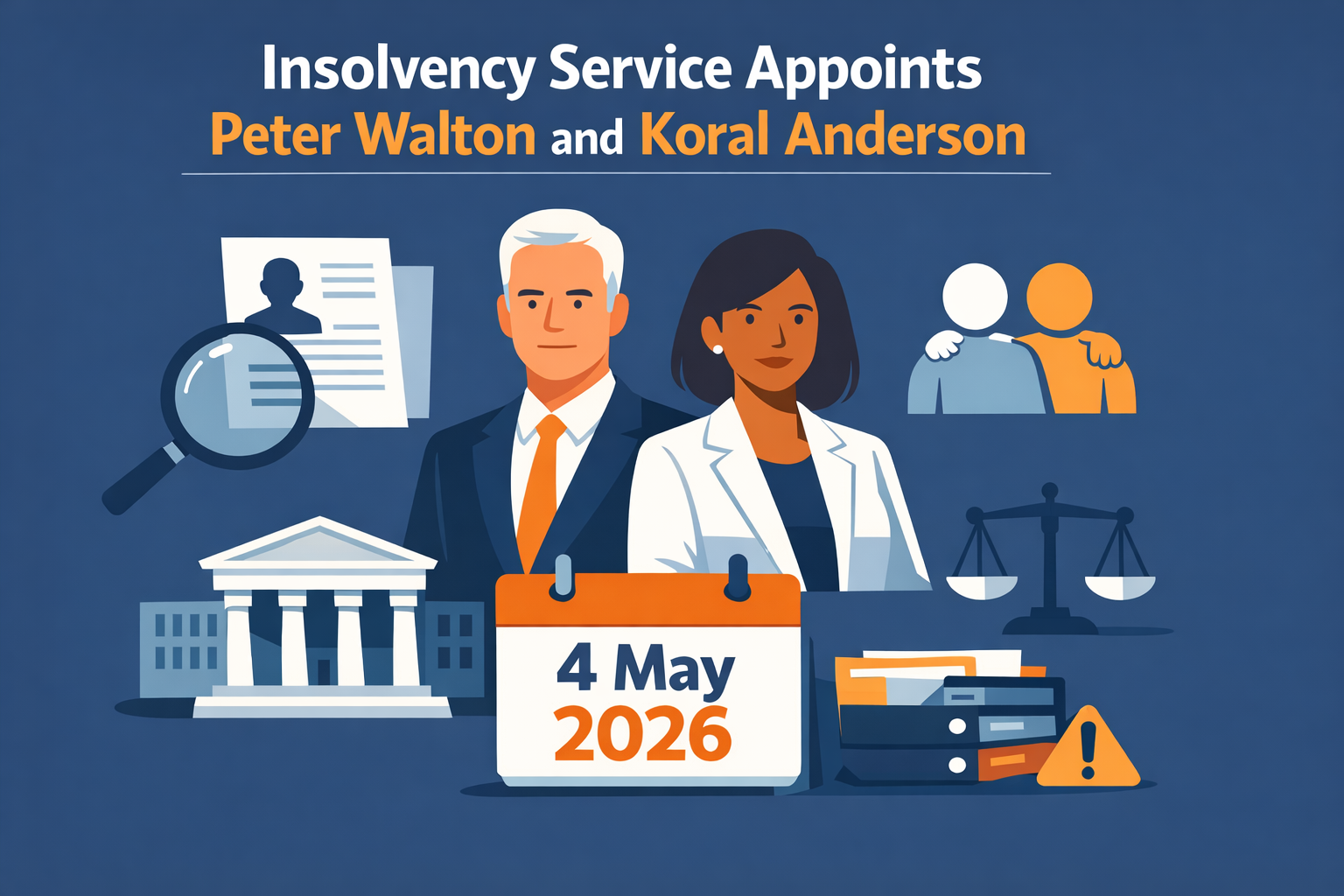
In a GOV.UK announcement published on 4 May 2026, ministers confirmed Peter Walton and Koral Anderson as new Non-Executive Directors on the Insolvency Service board. Non-executive directors are board members brought in to challenge and oversee rather than run daily operations. Both appointments begin on Monday 4 May 2026 and run for three years, ending in May 2029. The government says the pair will help the agency support those in financial distress, tackle financial wrongdoing and maximise returns to creditors. For directors, that official wording needs translating into plain English. The Insolvency Service sits close to the point where business failure can turn into investigation, disqualification action or bankruptcy administration, so board appointments matter well beyond Whitehall.
Walton arrives with a long academic record in insolvency law. The government release says he has been Emeritus Professor of Insolvency Law at the University of Wolverhampton since 2024, after serving as Professor from 2013 to 2023 and building a career spanning almost four decades. It also says he has advised government and professional bodies, contributed to major UK insolvency reforms and held senior roles in insolvency education and technical governance. That background will interest directors for one reason in particular: Walton's work covers corporate rescue as well as insolvency law. If the board is serious about earlier intervention and workable rescue routes, his appointment gives it credible expertise. If not, directors will be entitled to ask why a board with that level of knowledge still presides over a system many business owners experience only when the position has already become critical.
Anderson comes from a very different side of the market. According to GOV.UK, she has been Barclays' Head of Transformation since 2022, with responsibility for large-scale change across operations, digital, data, procurement and cost programmes. The release adds that she previously held senior Chief Operating Officer and regulatory leadership roles at Barclays, and earlier senior posts at Deutsche Bank and Goldman Sachs. For directors, this is not a minor CV detail. A board member steeped in banking operations and regulatory control is likely to focus on delivery, systems, measurement and process discipline. That could mean better oversight and quicker decisions. It could also mean a harder-edged, more standardised approach unless the board stays alert to the fact that distressed companies are not spreadsheet entries but employers, taxpayers and trading businesses under pressure.
Non-executive directors do not decide the fate of an individual company from the boardroom, but they do ask questions about strategy, performance, risk and accountability. That is why these appointments matter to company officers, including directors who may already be facing queries about conduct, record-keeping or creditor losses. The test is not whether the new board members have impressive biographies. The test is whether they press the Insolvency Service on how quickly it acts, how clearly it explains its decisions and how fairly it separates genuine misconduct from the ordinary mistakes that often arise when a business is fighting for survival. Directors do not need more slogans about economic confidence. They need predictable standards and proportionate treatment.
The immediate legal position for directors does not change because two new non-executives have joined the board. If a company is insolvent or likely to become insolvent, directors still need to protect creditor interests, keep proper books and records, avoid worsening losses and take independent advice early. Those duties remain exactly where they were before 4 May 2026. What should change is how directors read official announcements like this one. A board appointment is not a rescue plan, and it is not a reason to drift. If your business is under strain, the sensible route is to review cashflow now, challenge any assumption that formal insolvency is the only answer, and look hard at options such as consensual creditor deals, HMRC Time to Pay, refinancing, a managed sale or a company voluntary arrangement, which is a binding deal with creditors, before control slips away.
For creditors and directors alike, the weakness in the government announcement is what it leaves unsaid. There is plenty on credentials, but very little on what success will look like by May 2029. Will the Insolvency Service publish clearer data on enforcement outcomes? Will it improve guidance for directors before failure becomes formal insolvency? Will it show more willingness to separate rescue cases from misconduct cases? Those are the questions worth asking as Walton and Anderson take their seats. For Director Freedom, the real story is not simply who joined the board on 4 May 2026. It is whether the Insolvency Service becomes more transparent, more disciplined and more useful to directors trying to do the right thing under pressure.