
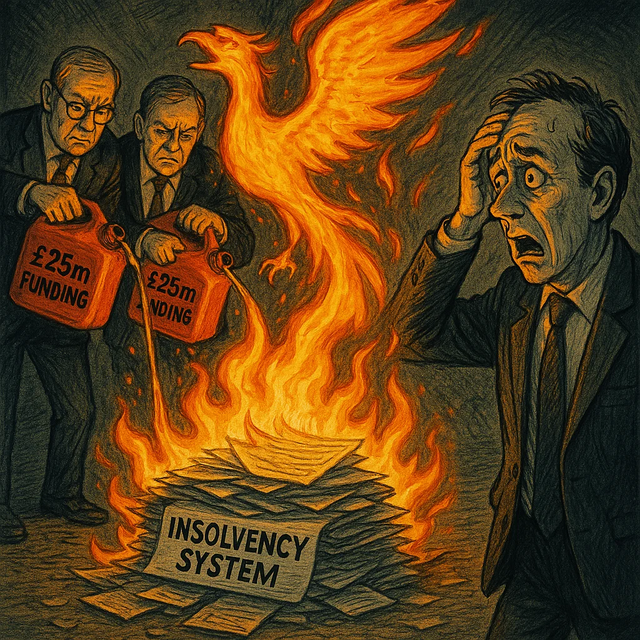
The Autumn Budget 2025 delivers £25 million to build a 50-person Abusive Phoenixism Taskforce inside the Insolvency Service. Government frames this as a crackdown on directors who close one company and reopen another. But here is the truth no one at Westminster is saying loudly: the insolvency industry itself is built on phoenixing. Pre-pack administrations, connected-party sales, asset transfers and business relaunches are everyday tools used by Insolvency Practitioners (IPs). The difference? When an IP does it, they call it a restructuring. When a director does anything similar before insolvency, it risks being labelled abuse. Directors must understand this double standard clearly if they plan to rescue their company lawfully.
Officials state that the new team will investigate suspicious insolvencies, recycled directors and value leakage. Dave Magrath from Investigation and Enforcement Services welcomes the funding, signalling more disqualifications for ‘failures in duties’. Their public statistics show a sharp rise: over 1,000 disqualifications and dozens of public-interest wind-ups last year. More budget means more investigators, more scrutiny, more files opened and inevitably more borderline cases dragged into enforcement. Good directors will be caught by proximity unless they prepare properly. If you cannot evidence what you did and why, you risk being swept into a narrative that was never meant for you.
Abusive phoenixism is not a legally defined offence; it is a pattern of behaviour. Typically the story goes: liabilities disappear, assets and trading names move to a new shell, creditors are left with nothing and directors carry on. But context matters. Most directors who end up looking like this are not criminals – they are overwhelmed, badly advised, or pushed into a rushed CVL by an IP without exploring pre-insolvency corrections. And ironically, phoenixing becomes ‘acceptable’ when an IP oversees it after formal insolvency. This is why directors must be extra cautious if they act before a wind-up: poorly documented pre-insolvency movements can be unwound, or worse, misinterpreted.
A legitimate phoenix is entirely lawful when done correctly – and in fact, much of the UK’s insolvency framework relies on exactly this. IPs routinely sell assets back to existing directors. They routinely allow businesses to continue under new entities. They routinely facilitate continuity of trade. None of this is inherently wrong. The law only requires that the process be fair, transparent, and supported by evidence: independent valuation, proper marketing, clear payment into the insolvent estate, and compliance with the Insolvency Act name-reuse rules. Directors who follow these steps should not be collateral damage. The problem is not phoenixing; it is bad phoenixing.
The new taskforce will likely target repeated insolvency patterns: multiple liquidations with identical VAT/PAYE debts, repeated use of the same trading style without following section 216 procedures, and asset sales between connected companies with weak marketing. They will also look at dissolutions used to sidestep tax. The frightening thing for genuine directors is that a perfectly legitimate rescue can visually resemble the same patterns. This is why directors must ensure their rescue has an audit trail that is stronger than the assumptions made by inspectors.
Investigators will request bank statements, VAT and PAYE filings, management accounts, fixed-asset registers, valuation reports, engagement letters with advisers, board minutes and email trails documenting decisions. Missing, inconsistent or late responses are treated as red flags. These issues often arise not from wrongdoing but from chaos – directors trying to trade, firefight, and manage a failing business without proper support. If your records are incomplete, recover everything now: accountants, cloud systems, lenders and suppliers will all hold pieces of the puzzle. A director with clean, organised paperwork is rarely mistaken for a rogue.
If you plan any form of rescue, your protection begins before action. Document every step. Minute the decision to seek advice. Obtain RICS-grade valuations and store the full reports. Market assets properly if selling to a connected party – not just a token email, but real marketing that proves fair value. Ensure the purchase price is actually paid into the estate. If you intend to reuse a name, follow the statutory notice or court-permission route. These are simple steps, but once missed, they are impossible to fix retrospectively – and this is where honest directors get hurt.
A key message from Director Freedom is this: do not assume a CVL is the safest option. The insolvency industry would like you to believe that, but in reality a CVL is often the start of deeper scrutiny, not the end of your problems. You are far better off reducing liabilities before any formal process – correcting tax, identifying overpayments, challenging penalties, renegotiating creditor balances, or seeking time-to-pay arrangements. Many directors can resolve their situation entirely without touching insolvency. Others can restructure outside a CVL, preserving value and avoiding the formal stigma that triggers automatic investigations.
Unregulated ‘phoenix facilitators’ offering magic solutions are dangerous, but so too are IPs who rush directors into a CVL without exploring pre-insolvency correction. If someone tells you assets must be moved post-insolvency to be legitimate, remember that the *only reason* this is accepted is because the system is built to funnel fees through IPs. Directors can often achieve better, safer outcomes pre-insolvency – if they do it correctly, transparently and with proper valuation. Before agreeing to any plan, demand SIP 9 fee clarity, conflict disclosures and evidence of how a connected-party sale will be justified to creditors.
If you receive a disqualification warning, treat it as serious. Bans range from 2 to 15 years, often followed by compensation orders. Early engagement with solid evidence is critical. Show valuation reports, show creditor treatment, show board decisions, show fairness. Never sign a disqualification undertaking without advice. And never attempt to fight an allegation without an evidential strategy. The Insolvency Service increasingly pushes undertakings because they are efficient; directors must not accept them by default.
This taskforce forms part of a wider government crackdown on economic crime – expanding compliance checks, tackling counterfeit goods, and reinvesting recovered funds. The Insolvency Service’s five-year strategy aims to position it as the UK’s primary enforcer of corporate behaviour. More money equals more investigations, more decisions, and more borderline cases pulled in. Directors should demand transparency, insist on seeing the evidence relied upon, and challenge inconsistencies. The system must justify its judgments, not rely on fear.
Director Freedom’s message is straightforward: enforcement against genuine abuse is necessary, but honest directors must not be drowned in the noise. Phoenixing is not the problem – bad phoenixing is. And ironically, the insolvency system depends on phoenixing when it is fee-generating for IPs. The best protection is preparation: reduce liabilities before any insolvency conversation, document value, clean up records, and refuse to be rushed into a CVL. Build the evidence now, before the taskforce comes looking later.