
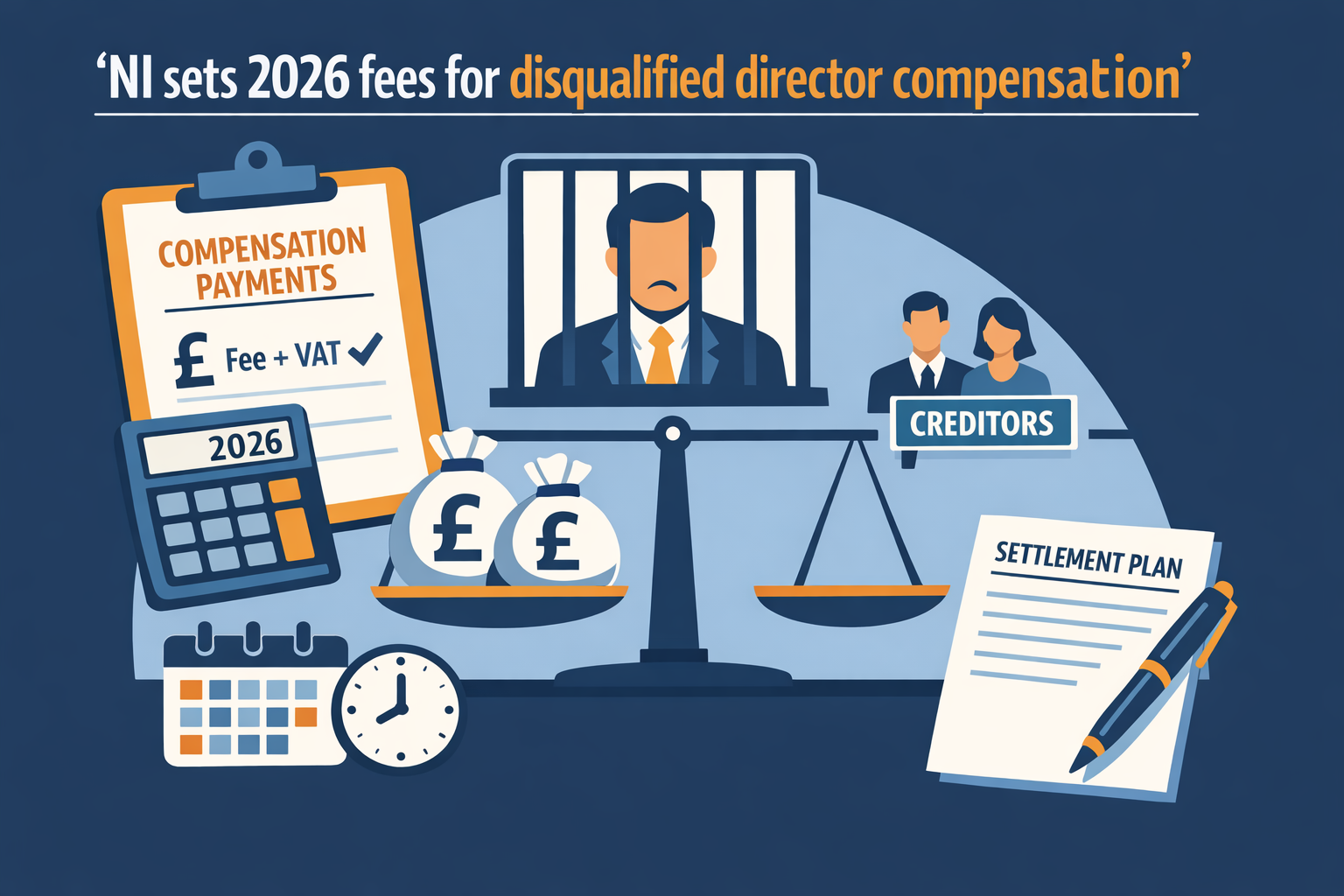
Directors in Northern Ireland now face a new cost variable when compensation is recovered from disqualified directors. A Department for the Economy Order made on 11 February 2026 introduces a time‑costed distribution fee, deducted from any sum the Department receives under a compensation order or compensation undertaking before money reaches creditors. Commencement is the day after the Assembly affirms the Order. The instrument was sealed by Economy Minister Dr Caoimhe Archibald with Department of Finance concurrence, signalling that distribution costs will now be carved out at source from recoveries for creditors.
The mechanism is blunt. The Department bills for the time its officials spend distributing the money, charged at hourly rates set out in a Schedule aligned to the Insolvency Service grading structure, plus any necessary disbursements or expenses properly incurred. That aggregate is then divided equally across every creditor named in the order or undertaking, regardless of claim size, and taken from the pot before distributions are made. VAT, if chargeable, is added on top and also taken from the same pot before payment to creditors.
For directors, this means the sum you agree to pay under a compensation undertaking is not the sum creditors will see. The distribution fee, expenses and VAT come off first. If your objective is to make good specific creditor losses or preserve relationships with key suppliers, you will need to account for this haircut when modelling settlement or when weighing up whether to contest quantum.
For creditors, the equal‑per‑creditor split is the headline risk. A micro‑creditor and a major institutional claimant will each bear the same share of the Department’s fee, even though their recoveries could be very different in cash terms. Before any distribution, ask the Department to confirm precisely who is on the “specified creditors” list, the recorded time by official grade, and any third‑party disbursements proposed so you can see the effect on your net receipt.
Compensation orders and undertakings in Northern Ireland stem from Article 19A of the Company Directors Disqualification (Northern Ireland) Order 2002. The Department for the Economy can apply for a compensation order, and it can accept a compensation undertaking. Procedural rules introduced in 2025 clarified how such cases move through the High Court and confirmed a two‑year window from the date of a disqualification order or undertaking for an application to be made. Equivalent provisions have existed in England and Wales since 2015. (napiers.com)
Usage to date in Great Britain has been selective rather than routine. As late as November 2023, the English court had only made the second reported compensation order against a director, underscoring that this remedy is used sparingly and usually where other routes will not return money to creditors. Northern Ireland’s new fee regime now sets out what it will cost government to pass on any compensation it actually receives. (taylorwessing.com)
The Order’s Explanatory Note says no regulatory impact assessment has been produced because no impact on the private or voluntary sectors is foreseen. Directors and creditors will spot the tension: every pound charged in administrative time and VAT reduces distributions to private creditors. That may be defensible as cost recovery, but it still changes the arithmetic for anyone relying on a compensation order to deliver redress.
Directors considering a compensation undertaking should get the distribution piece priced and documented early. Ask the Department for the Economy to share the Schedule of hourly rates by grade, a forecast of the work they expect to do, and confirmation of any external disbursements they may incur. Press for an estimate or cap where possible, and for staged distributions so billing can be checked against contemporaneous time records before the next tranche is paid.
It is also reasonable to ask whether the Department would accept an undertaking structure that minimises administrative handling. For example, in some cases it may be possible to agree terms that provide for direct settlement to identified creditors under Department oversight, reducing Department time on distribution. If central collection is required, seek clarity on what tasks will be carried out by which grade and why, and ask that timesheets identify the creditor workstream so you can reconcile the equal split back to the recorded activity.
Creditors should request an itemised statement showing hours by official grade, the applicable hourly rates, and all disbursements with receipts. Ask how VAT is being applied and to whom any VAT invoice will be addressed. If the equal split produces obvious unfairness in your case, challenge the recorded time and necessity of tasks before funds are disbursed, and keep a written audit trail for any complaint or review you may later pursue.
Where an office‑holder is already pursuing recovery for the same conduct, coordination matters. In England and Wales the Secretary of State is unlikely to seek a compensation order where a liquidator or administrator is recovering on the same facts. Directors and creditors should therefore engage with the office‑holder and the Department early to avoid duplicated effort or crossed wires about who is returning what-and on what timetable. (taylorwessing.com)
Finally, timing. The Order was made on 11 February 2026 and starts the day after it is affirmed by the Assembly. Until the approval date is confirmed, treat distribution costs as a near‑term reality and plan as if they will bite. This is a government fee, not an insolvency practitioner charge, but the same scrutiny applies: insist on grade‑coded time records, justification for disbursements, and written explanations for any deviation from estimates before money leaves the door.